
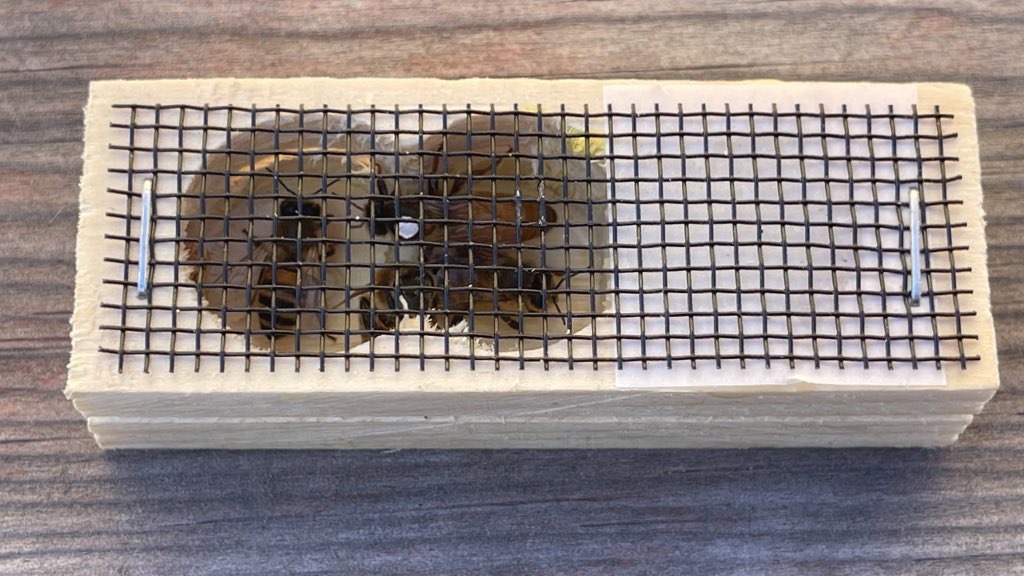
Alone and in a foreign new land, the colony could begin to heal, but their ruler had already perished.
The bee hive I keep with my wife was moved to a new location back in June and from what we could tell the hive seemed much better off in the new location. There was more to forage for and they weren’t as near to people. Previously they were on my wife’s uncle’s property, about a dozen feet from his garden. We new it would take a little while for them to adjust but slowly they did.
The hive seemed healthy and happy but was it?
The bee’s that were dying due to pesticide or starvation began to abate after a week or two. We hoped for some kind of honey harvest again this year but that didn’t happen because of the move and because we lost so many bees. For the time though back in the heat of June and July the bees seemed alright. We thought that was the case until we started to notice a disruption in the brood pattern. The hive seemed healthy and happy but was it?
Normally during that part of summer we should have seen a good amount or larva, egg, and capped over brood cells in the hive. It is always warm year around where we live so it makes for good laying conditions for the queen. The pattern of the capped over brood started to look spotty at best, a handful of cells on each frame.
New worker bees are a bill of health for a hive.
Our discovery of the diminished amount of new brood in the hive started to concern us and after another week we did a full inspection of the hive. We pulled out every frame in the hive looking at larva or the lack thereof and also were keeping our eyes open for the queen. We’d had this queen for roughly a year since our hive swarmed and half of it flew away. After that things seemed ok but only for a time. From top to bottom, we never saw any sign of the queen and noticed a distinct dearth of new young bees. New worker bees are a bill of health for a hive.
There were no uncapped brood in the hive so the workers couldn’t turn a normal larva into a queen again like they had the last time we’d lost a queen. The spotty brood pattern meant that the old queen was dead or had left the hive and the workers were trying to lay eggs. All normal worker bees can only lay male eggs so this would be an issue very quickly for us. The workers in disarray think they could become the next queen, but they’d never due.
I swear you would think these are Spartan bees…
Lucky for us there was a local queen breeder about twenty minutes away. He raised a special kind of queen that was mite resistant. Mites will live inside pupal chambers and deform larva and baby bees, crippling their ability to fly. A mite resistant queen, from what I understand breeds workers that check for mites in larva chambers and if any mites are found then larva are thrown from the hive. I swear you would think these are Spartan bees since they dash their young upon the rocks to strengthen their colony.
With the new queen imprisoned in a cage, with a few attendant bees, we introduced her to the hive and closed it up. Supposedly the bees would eat through the block of sugar that stopped them from getting to the queen too quickly. The idea is that they will become accustomed to her scent and then accept her as their new queen, but if you introduce a queen to a queenless hive too late then they may never accept her. The new queen was installed in the hive, so we left her for a week and hoped for the best.
On our return visit to the hive we assumed all had gone well, but we knew so little. We found bees in the queen cage and the queen crumpled up and curled in on herself. They’d killed the queen, she’d been stung to death. They hadn’t accepted her. Incredibly discourage and not sure what to do we talked to the queen breeder to see if we’d done anything wrong and his advice was, “Somtimes new queens just don’t take.” He gave us another queen and said to try again.
…only a few were trying to sting her…
When we went out again with a second queen, we weren’t really sure what to do now because the first one hadn’t worked out. We put the queen on top of the open hive and watched the bees interact with the queen cage. They were interested and only a few were trying to sting her through the mesh wire. We tucked her into the hive and decided to check back the next day.
Arriving the next day we were nervous we’d find another dead queen, twenty-six dollars isn’t cheap for a single insect. We popped open the hive and took the queen cage out. We saw that the bees had almost eaten through the sugar cube into her cage. Placed on top of the hive we watched the other bees interact with her again. They seemed interested in her, but not aggressively so. Some of them did a small bee wobble, apparently it is called a dance. We decided to release her and hope for the best. If the bees did start to attack her we could pull her out and rescue her.
A few worker bees rushed into her cage…
With the cork removed we set her back down on the hive and waited. A few worker bees rushed into her cage and then rushed back out. Most of the other bees were interested but didn’t know how to get in yet. She hadn’t moved out yet either. In a flash she darted out of the cage and dove down in between the frames. We let her get her bearings for a couple minutes and then decided to go looking for her to make sure had been attacked.
A few frames over from where we saw her enter the hive we found her. She was tromping around slowly, a giant compared to the other bees, and all the other bees were interacting with her in a gentle interested manner, no stingers involved. Thankful that she’d been accepted we buttoned up the hive up with the new queen inside.
Now our hive is doing quite well, no honey yet, someday hopefully. For now it is a good reminder to enjoy what you are doing and not be too worried with the outcome. We’re thankful we get to keep a box of bees…that killed their old queen. Long live the queen.

 A Few Things After Words
In terms of the queen bee can you feed the worker bee larvae royal jelly? Its tough I know. If you can, isolate a few larvae which should be female. Feed them until they develop enough to be ‘adopted by the worker bees that will finish feeding her until maturity. Its a long shot. I have watched it be done years ago, but I have not tried it personally. Good luck.
David Rose
Twitter @dmrose15
LikeLiked by 1 person